20 Korean Universities Just Lost the Right to Freely Sponsor Visas

South Korea’s education and justice ministries imposed new Korea university visa restrictions on 20 universities in September 2026. The limits cap how many international students those schools can sponsor for a D-2 degree or D-4 language-program visa. Sixteen schools face restrictions on their degree programs, and four on language programs. The restrictions follow a government review of how well each university manages its international student population.

Korea university visa restrictions affect international students in classrooms like this

How the Korea university visa restrictions work

South Korea’s Ministry of Education and Ministry of Justice jointly run an evaluation called the International Education Quality Assurance System, or IEQAS. It scores universities on international student management, rates of illegal residency, internationalization infrastructure, and how appropriate their student selection process is. The review also weighs graduate outcomes, dropout rates, language proficiency standards, and overall student satisfaction. Universities that score poorly lose the ability to freely sponsor new international student visas for a one-year restriction period. Schools identified as “excellent certified” institutions, 39 in total, get expedited visa screening instead.

Why the government is tightening oversight

The restrictions target a specific problem South Korean authorities have flagged repeatedly. A rising number of international students arrive on legitimate study visas. Some later fall out of status, working illegally or overstaying after leaving their sponsoring university. The government now links visa sponsorship privileges directly to a university’s track record on managing this risk. That pushes the compliance burden onto the institutions themselves, not just border or consulate screening.

What it means for prospective students

Anyone applying to study in South Korea should check a university’s IEQAS certification status before applying. Admission to one of the 20 restricted schools does not guarantee a visa will be issued or that entry will proceed smoothly. Students already admitted to a restricted university may need to consider transferring to a certified institution to avoid delays. For those targeting a degree program, one of the 16 D-2 restrictions means a more difficult visa approval process. For the four schools facing D-4 restrictions, language-program applicants specifically face the added scrutiny.

How this compares with other countries’ approaches

South Korea’s move mirrors steps other popular study destinations have taken as international student numbers have grown. Australia and Canada have both tightened their own student-visa integrity checks in recent years. Both now tie visa issuance more closely to an institution’s compliance record, rather than treating every accredited university the same. The shared logic is simple: concentrate scrutiny on the institutions with the weakest oversight. That catches more of the actual problem while leaving well-managed universities largely unaffected.

What happens over the restriction period

The current restrictions run for one year. After that, the 20 affected universities can be reassessed under the same IEQAS criteria. Schools that show improved student management, lower illegal-residency rates, and stronger internationalization practices could regain full sponsorship privileges then. Continued weak performance could instead extend or deepen the restrictions. Prospective applicants should watch for updated IEQAS certification lists as the review cycle continues. Education agents who place students in South Korea are also expected to face closer scrutiny under the same broader review, since the government has flagged agent conduct as a contributing factor in some of the compliance problems the IEQAS process was designed to catch.

Frequently asked questions

How many Korean universities are affected by the visa restrictions?

Twenty universities in total. Sixteen face restrictions on D-2 degree program visas, and four face restrictions on D-4 language program visas.

Which government bodies run this review?

South Korea’s Ministry of Education and Ministry of Justice jointly administer the review through the International Education Quality Assurance System, or IEQAS.

What criteria determine a university’s IEQAS score?

Factors include international student management, illegal residency rates, internationalization infrastructure, student selection practices, graduate outcomes, dropout rates, language proficiency and student satisfaction.

What should students already admitted to a restricted university do?

They should check the school’s current IEQAS certification status and consider whether transferring to a certified institution would reduce visa-related delays.

How long do the Korea university visa restrictions last?

The current restriction period runs for one year, after which affected universities can be reassessed under the same criteria.

Are any universities exempt from extra visa scrutiny?

Yes. Thirty-nine universities identified as ‘excellent certified’ institutions receive expedited visa screening rather than restrictions.

The bigger picture for Korea’s international education sector

South Korea has actively courted international students over the past several years. The push is part of a broader strategy to offset its declining birth rate and shrinking university-age population. Government targets call for substantial growth in foreign enrollment by the end of the decade. That expansion push makes oversight mechanisms like IEQAS especially important to the government’s credibility. Rapid enrollment growth without matching quality controls has, in other countries, led to scandals involving diploma-mill institutions and visa fraud. Those scandals eventually damaged the reputation of the entire national system. By tying visa sponsorship to measurable outcomes rather than blanket approval, Korean officials are signaling their intent: grow international enrollment without repeating those mistakes.

More on studying and working abroad

For more on how study-abroad rules are shifting this year, see our coverage of the Knight-Hennessy Scholars application deadline and Australia’s working holiday visa changes.

Sources

You Have Until 6 October to Land a Fully Funded Stanford Degree

If a fully funded graduate degree at Stanford is on your list, the clock is short. The
Knight-Hennessy Scholars deadline to join the 2027 cohort falls at 1:00pm Pacific Time on
6 October 2026. That is under two weeks away, and the application is not one you can rush at the last hour.

The Knight-Hennessy Scholars deadline, precisely

The application closes at 1:00pm Pacific Time on 6 October 2026, according to the
program’s official deadlines page.
The date is the same for every applicant, whatever Stanford degree you pursue. Convert it to your own time
zone and treat the earlier moment as your true cut-off, not midnight.

Sandstone arcade at Stanford, the campus behind the Knight-Hennessy Scholars deadline
Knight-Hennessy scholars pursue any full-time graduate degree at Stanford.

What the award actually covers

Knight-Hennessy funds up to three years of any graduate degree at Stanford. According to the
program’s funding page,
each of the first three years includes:

  • A fellowship applied directly to tuition and associated fees
  • A stipend for living and academic expenses
  • A travel stipend for one annual economy round-trip to Stanford
  • A one-time relocation stipend for newly enrolling scholars

For degrees that run longer than three years, such as a PhD or MD, the degree program funds the
remaining years under its own standard commitment. The stipend is taxable, and the program does not
reimburse taxes, so budget for that.

The scale of the award is what sets it apart. Knight-Hennessy is one of the largest fully funded
graduate fellowships in the world, and it is open across every discipline Stanford teaches. There are no
quotas by field or world region. That breadth is rare. Most large scholarships tie you to one subject or
one degree; this one follows you into whatever full-time Stanford graduate program admits you.

Who is eligible for the Knight-Hennessy Scholars deadline

The program encourages applicants from every country and sets no quotas by discipline or world region.
Two baseline rules apply. First, you must also apply to, be admitted to, and enrol in a full-time Stanford
graduate program. Second, you must have earned your first bachelor’s degree in January 2020 or later.
Applicants who served in the military get two extra years of eligibility.

This is the crucial catch: Knight-Hennessy and Stanford graduate admission are two separate
applications. Your degree program deadline may fall before or after 6 October, and it varies by program.
Confirm it directly with the department.

What to do before the deadline closes

With under two weeks left, work backwards from 6 October.

  1. Lock your recommenders today. Two letters take the longest and are outside your control.
  2. Draft the essays and short answers. The program wants evidence of independence of thought, purposeful leadership and a civic mindset.
  3. Confirm your Stanford program deadline. Missing that application makes you ineligible for Knight-Hennessy, even with a perfect scholarship submission.
  4. Check transcripts and test scores. Order anything that ships slowly now.

If Stanford is one of several targets, keep other funded routes open. Our guides to the
Chevening scholarship deadline
and the DAAD EPOS scholarship
cover fully funded options in the UK and Germany with their own autumn timelines.

Working back from 6 October

The single most common way strong candidates fail is treating the two applications as one. They are not.
Knight-Hennessy closes on 6 October; your Stanford degree program has its own deadline, which for some
programs is the earlier of its own date or 1 December 2026. Map both dates now. Then protect the recommender
timeline, because a late letter can sink an otherwise excellent file. If you cannot finish a competitive
application by 6 October, it is usually better to aim for next year’s cycle than to submit a rushed one.

Common questions about applying

When is the Knight-Hennessy Scholars deadline?

The application to join the 2027 cohort closes at 1:00pm Pacific Time on 6 October 2026. The deadline is the same for all applicants regardless of degree program.

What does the scholarship cover?

Full funding for up to three years of any Stanford graduate degree: a fellowship covering tuition and fees, a living stipend, a travel stipend, and a one-time relocation stipend for new scholars.

Who can apply?

Citizens and residents of any country. You must also apply to and be admitted to a full-time Stanford graduate program, and you must have earned your first bachelor’s degree in January 2020 or later.

Do I need to apply to Stanford separately?

Yes. Knight-Hennessy is separate from Stanford graduate admission. You submit two applications, and the graduate program deadline can differ from the 6 October Knight-Hennessy date.

Does it cover PhD or MD programs longer than three years?

Knight-Hennessy funds up to three years. For longer programs such as a PhD or MD, the degree program covers the remaining years under its own standard funding commitment.

Can I defer a Knight-Hennessy offer?

No. The program does not defer scholar offers. If selected and unable to enrol, you must reapply for the year you intend to start.

Sources

Featured image: Stanford campus arcade, photo by DanWri, licensed CC BY.

A Judge Paused the Rule That Would Cap Student Visas at Four Years

The duration of status rule that would have capped student and exchange visitor stays
at four years is on hold. On 14 September 2026, the US District Court for the District of Massachusetts
issued a nationwide preliminary injunction postponing the effective date of the Department of Homeland
Security’s final rule, one day before it was due to take effect. The long-standing duration of status
framework stays in place while the case continues.

What the duration of status rule would have changed

DHS published the final rule on 17 July 2026. It would have ended open-ended admission for F-1 students,
J-1 exchange visitors and I media representatives, and replaced it with fixed admission periods.

Under the rule, F-1 and J-1 holders would generally have been admitted to the end of their programme or
for four years, whichever came first. The grace period after completion would have dropped from 60 days to
30. Anyone needing longer would have had to file for an extension of stay rather than simply remaining in
valid status.

International students at a university fair affected by the duration of status rule
Doctoral programmes routinely run past four years, which is where the rule bit hardest.

Why the court paused the duration of status rule

District Judge F. Dennis Saylor IV took the case. The court cited administrative complexity and the
impracticality of running parallel regulatory frameworks across institutions and students nationwide. In
plain terms, the changeover itself looked likely to cause more disruption than the rule could justify
while its legality remained unresolved.

A preliminary injunction is not a ruling on the merits. It suspends the rule so that the litigation can
proceed without the disputed policy taking effect in the meantime. Courts grant one when the challengers
look likely to win and the harm from letting the policy start would be hard to undo.

Who this affects most

Doctoral candidates carried the sharpest risk. Consider an Indian engineering PhD student in her third
year of a programme that typically runs five to six years. Under the rule she would have hit the four-year
ceiling mid-research and needed an extension of stay filing to continue, with the processing delay that
implies. Under the current framework she simply remains in status while enrolled.

Language programmes, medical residents on J-1 status and foreign correspondents on I visas also fell in
scope. Undergraduates on four-year degrees faced the least exposure, though even they would have lost half
the grace period.

University administrators had their own problem. Running two admission frameworks side by side means
two sets of advising rules, two compliance workflows and two ways to make an honest mistake that costs a
student their status. That practical burden shaped the court’s reasoning.

How this fits the wider immigration picture

This is the second recent instance of a court stopping a DHS rule before it started. It also sits
alongside changes that did take effect, including the stricter public charge test now applied to green
card filings. Our coverage of
what the public charge change does and does not apply to
and
the separate birth tourism rule a court blocked
sets out the pattern. Students weighing alternatives may also want
the latest Canadian Express Entry draw figures.

Where the litigation goes from here

DHS can appeal the injunction to the First Circuit. It can also go back and issue a revised rule that
tries to answer the court’s practical objections. Either route takes months. In the meantime the operative
question for anyone on an F, J or I visa is simple: nothing about your current admission has changed.

Track the case through
NAFSA’s litigation page
and
the Presidents’ Alliance case tracker,
both of which post filings as they land. Your own school’s international office is the source that applies
to your specific record.

Duration of status rule: common questions

Is the duration of status rule in effect right now?

No. A federal court postponed its effective date on 14 September 2026. The existing duration of status framework still applies to F-1, J-1 and I visa holders.

What would the rule have changed?

It would have replaced open-ended admission with a fixed period: the end of the programme or four years, whichever is shorter, plus a 30-day grace period instead of 60 days.

Does the injunction cover everyone or only the plaintiffs?

The court issued a nationwide preliminary injunction postponing the rule’s effective date, not a party-specific order.

Is this a final decision?

No. A preliminary injunction suspends a rule while litigation continues. DHS can appeal, and the case can still be decided either way.

Do I need to file anything differently?

Not because of this order. Your I-20 or DS-2019 and your existing admission terms are unchanged. Check with your designated school official or responsible officer before acting on anything you read online.

Could the rule come back?

Yes. DHS could win on appeal, or issue a revised rule addressing the court’s concerns. Treat the current position as a pause, not a cancellation.

Sources

The Student Visa Rule Due Today Just Got Frozen by a Judge

A federal judge has frozen the rule that was due to end duration of status today. The
duration of status injunction came from the U.S. District Court for the District of
Massachusetts on 14 September 2026. It postpones the effective date of a Department of Homeland Security
final rule. That rule would have replaced open-ended admission with a fixed term for F-1 students, J-1
exchange visitors and I media representatives. DHS published it on 17 July. It was set to bite on 15
September. For now, it does not.

What the duration of status injunction actually does

Judge F. Dennis Saylor IV granted a nationwide preliminary injunction. The order postpones the rule’s
effective date while the case proceeds. It does not strike the rule down. That distinction matters. DHS can
still defend the rule, and an appeal court could narrow or lift the order.

The court found the plaintiffs likely to succeed on their claim that the rule breached the Administrative
Procedure Act. That statute governs how federal agencies write rules. Courts use it to test whether an
agency explained itself and followed the required process.

The plaintiffs are a coalition rather than a single school. They include NAFSA: Association of
International Educators, the Presidents’ Alliance on Higher Education and Immigration, and the Association
of Independent Colleges and Universities in Massachusetts. Three unions joined them: the American Federation
of Teachers with its Graduate Labor Organization local, the United Auto Workers with UAW Local 2322, and the
NewsGuild-CWA. The union presence reflects how many affected people work as teaching and research staff.

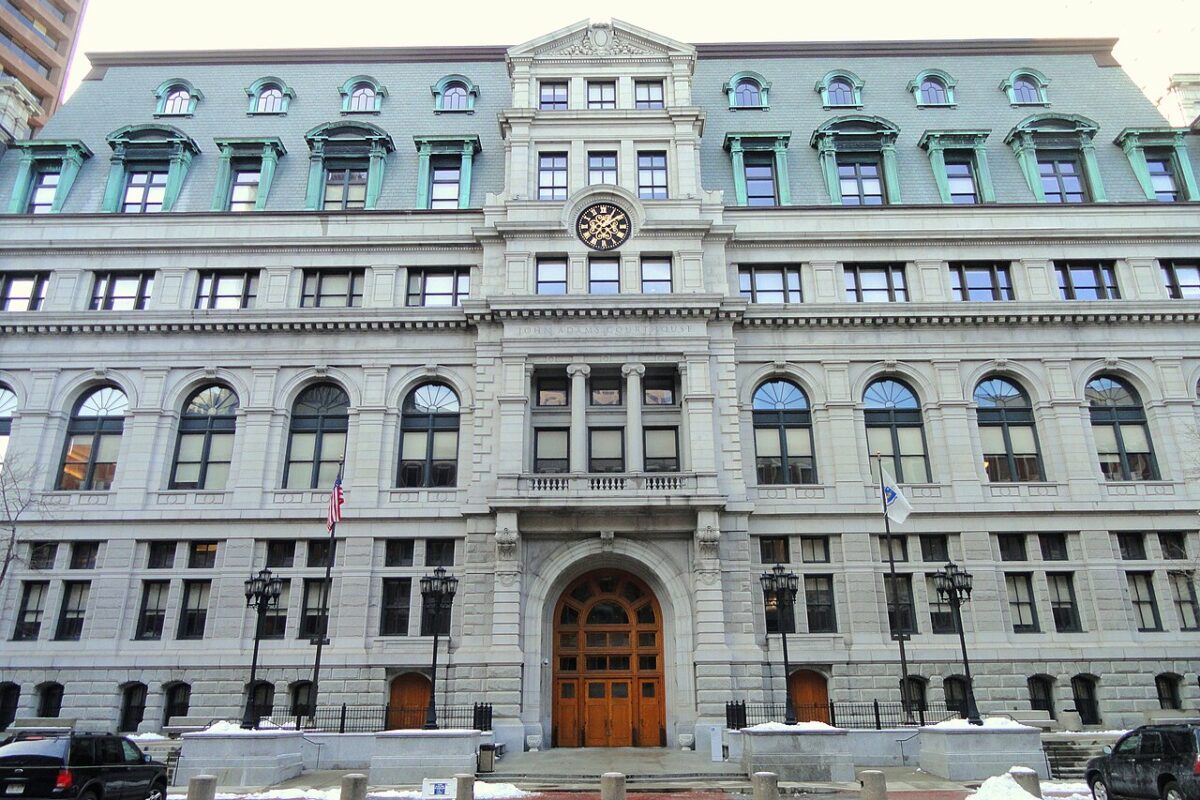
Federal courthouse in Boston where the duration of status injunction was issued
The Boston federal courthouse, where the order postponing the DHS rule was issued on 14 September 2026.

What the blocked rule would have changed

The July rule rewrote a system that has run since 1978. Under duration of status, an F-1 student stays
lawfully while they make progress in their programme. There is no end date stamped on the admission record.
The rule would have replaced that with a date certain.

The headline change was a cap. New admissions would run for the length of the programme or four years,
whichever was shorter. Anyone needing longer would file an extension of stay with U.S. Citizenship and
Immigration Services and show a compelling reason. A pending extension would carry an automatic 240-day
authorisation.

The grace period after finishing a programme would have dropped from 60 days to 30 for F visa holders.
Students who completed one level could move up to a higher degree, but not sideways or down. Graduate
students would have been barred from changing educational level or major at any point. Undergraduates would
have faced that bar in their first year, absent extenuating circumstances. Dependants would have followed
the same fixed-term structure.

Consider a doctoral researcher from India in year five of a six-year programme. Under the old system her
status simply continued. Under the new rule she would have needed an approved extension, filed on time, with
a reason a USCIS officer accepted.

Who the duration of status injunction reaches

The order is nationwide. It is not limited to the plaintiffs or to Massachusetts. Every F, J and I visa
holder in the United States sits under the old framework while it stands.

Harvard’s International Office had spent weeks urging students to be physically inside the country on 15
September. On 14 September it said the rule now has no immediate impact on visas, or on starting an autumn
programme. Other universities issued similar notices. Read institutional guidance rather
than social media summaries, because each school phrases the practical advice differently.

One caution is worth repeating. An injunction is provisional. Travel plans built on the assumption that
the old rules will last all year carry real risk. The advice many advisers gave before the ruling — avoid
non-essential international travel while the litigation runs — has not stopped being sensible.

Where the case goes from here

Three things decide what students face next. The first is whether the government appeals to the First
Circuit and asks for a stay. The second is how the district court rules on the merits, which can take
months. The third is whether DHS withdraws the rule and issues a revised version with a fuller
justification.

Meanwhile the paperwork built for the rule is still arriving. USCIS moved to new editions of Form I-539
and Form I-765 dated 09/15/26, drafted partly around the fixed-term framework. Our companion piece on the
new USCIS form editions taking
effect today
sets out what to file and when. We also covered
the rule itself when
its effective date was still standing
, and the separate
public charge test arriving
on 18 September
, which is not affected by this order.

Common questions about the ruling

Is the duration of status rule dead?

No. A court has postponed its effective date while litigation continues. The rule still exists and the government can defend it.

Do I still get an open-ended admission?

While the injunction stands, yes. F and J admissions continue under duration of status rather than a date-certain I-94.

Does this change my 60-day grace period?

The cut from 60 days to 30 for F visa holders was part of the blocked rule. It is not in force while the order stands.

Should I travel internationally now?

Speak to your designated school official first. An injunction can be stayed on appeal, and the rules at the moment of re-entry are what count.

Which court issued the order?

The U.S. District Court for the District of Massachusetts, in a case brought by NAFSA, the Presidents’ Alliance, AICUM and several unions.

Sources

The UK Erasmus+ Return Gets Its Immigration Rules

Buried in the UK’s latest statement of changes to the Immigration Rules is the legal machinery for something the country walked away from six years ago. The UK Erasmus+ return now has its immigration groundwork in place, with a dedicated set of visitor provisions taking effect on 8 October 2026 ahead of the UK’s association to the programme from 2027.

The changes appear in HC 584, laid before Parliament on 3 September 2026.

A new category of permitted activity

The rules gain an “Erasmus+ Activities” section in Appendix Visitor: Permitted Activities, covering four things a visitor may now do under the programme:

  • Provide or receive training at a UK organisation or educational institution, provided the role is not a permanent one, where the visitor is employed by or works with an overseas Erasmus+ participating body, or qualifies as a Youth Worker.
  • Undertake a traineeship — for visitors aged 18 or under, for up to 30 days, subject to UK Working Time Regulations.
  • Job shadowing, confined to what the rules call participative observation and not amounting to filling a permanent role.
  • Sports coaching and training assignments at UK sports organisations, on the same non-permanent basis.

The rules define each term. Job shadowing means following practitioners in their daily work to exchange practice and build partnerships. A traineeship means time in a UK enterprise to gain work experience and specific competencies. A Youth Worker is a professional or volunteer providing social or professional development learning to young people.

Under-18s undertaking a traineeship or job shadowing must provide written permission from a parent or guardian and from their home institution.

The student route changes matter more than they look

Several amendments to Appendix Student carve Erasmus+ participants out of restrictions that apply to everyone else:

  • Work placement duration limits are disapplied. A work placement on a course taken by an Erasmus+ participant at a participating sponsor is exempt from the normal duration restrictions — a substantial concession, given how tightly placement time is otherwise capped.
  • State school study becomes possible. Students are normally barred from studying at a state school or academy. Erasmus+ participants at a participating sponsor are now an exception.
  • Lower qualification levels qualify. Erasmus+ courses at Regulated Qualifications Framework level 2 or above in England, Wales and Northern Ireland, or Scottish Credit and Qualifications Framework level 5 or above in Scotland, are permitted — below the usual degree-level threshold.

Taken together these are not tidying amendments. They rebuild the flexibility that made short-cycle European mobility work.

The exchange scheme route

Erasmus+ has also been added to the list of Government Authorised Exchange schemes, for participants undertaking eligible traineeships, teaching placements and training assignments. The listed overarching sponsor is IRARA Services Ltd, and the maximum stay is 12 months as a work experience programme.

Participants on placements outside those categories are directed to alternative immigration routes.

The Government Authorised Exchange framework is the Home Office’s standard mechanism for short-term structured placements, and routing Erasmus+ through it rather than inventing a bespoke route is a deliberately low-friction choice. It also means the arrangement can be adjusted without a fresh statement of changes, since scheme entries sit in a list. Previous statements are collected on the Home Office’s statement of changes page.

What this does not do

It does not make the UK a member of Erasmus+. Association is stated to run from 2027; HC 584 builds the immigration plumbing in advance so the rules are ready when the programme is.

It also does not restore what UK students lost. These provisions govern people coming to the UK. Outbound mobility for UK students depends on the association agreement itself and on the funding attached to it, neither of which is an immigration matter.

One number worth diarising

Separately in the same statement, student maintenance requirements rise on 30 November 2026: from £1,529 to £1,570 per month for study in London, and from £1,171 to £1,203 outside it.

Applications made before that date are decided under the current figures. For a nine-month course in London the increase adds roughly £369 to the funds an applicant must evidence — small in isolation, less so stacked on rising fees.

The broader October package, which touches ten routes, is covered in our earlier analysis of HC 584.

Timing, in order

  • 8 October 2026 — Erasmus+ visitor and student provisions take effect. Applications made before this date are decided under the rules in force on 7 October.
  • 30 November 2026 — maintenance funds increase.
  • 2027 — UK association to Erasmus+ takes effect.

Questions about the Erasmus+ provisions

Is the UK rejoining Erasmus+?

Association to the programme has been agreed from 2027. HC 584 puts the supporting immigration rules in place from 8 October 2026, ahead of that.

What can an Erasmus+ visitor do in the UK?

Provide or receive training, undertake a traineeship if aged 18 or under for up to 30 days, do job shadowing limited to participative observation, and carry out sports coaching or training assignments — none amounting to a permanent role.

Do Erasmus+ students get different treatment on work placements?

Yes. Work placements on Erasmus+ courses at participating sponsors are exempt from the usual placement duration restrictions.

Can Erasmus+ participants study at UK state schools?

Yes. They are an explicit exception to the general prohibition on students studying at a state school or academy.

When do the new maintenance amounts apply?

From 30 November 2026: £1,570 per month in London and £1,203 outside London. Applications made before that date use the current figures.

Does this help UK students study in Europe?

Not directly. These rules govern inbound mobility to the UK. Outbound opportunities depend on the association agreement and its funding, which are separate from the Immigration Rules.

For European study funding that is open to applicants now, see our guides to Erasmus Mundus Joint Masters and Commonwealth Scholarships.