
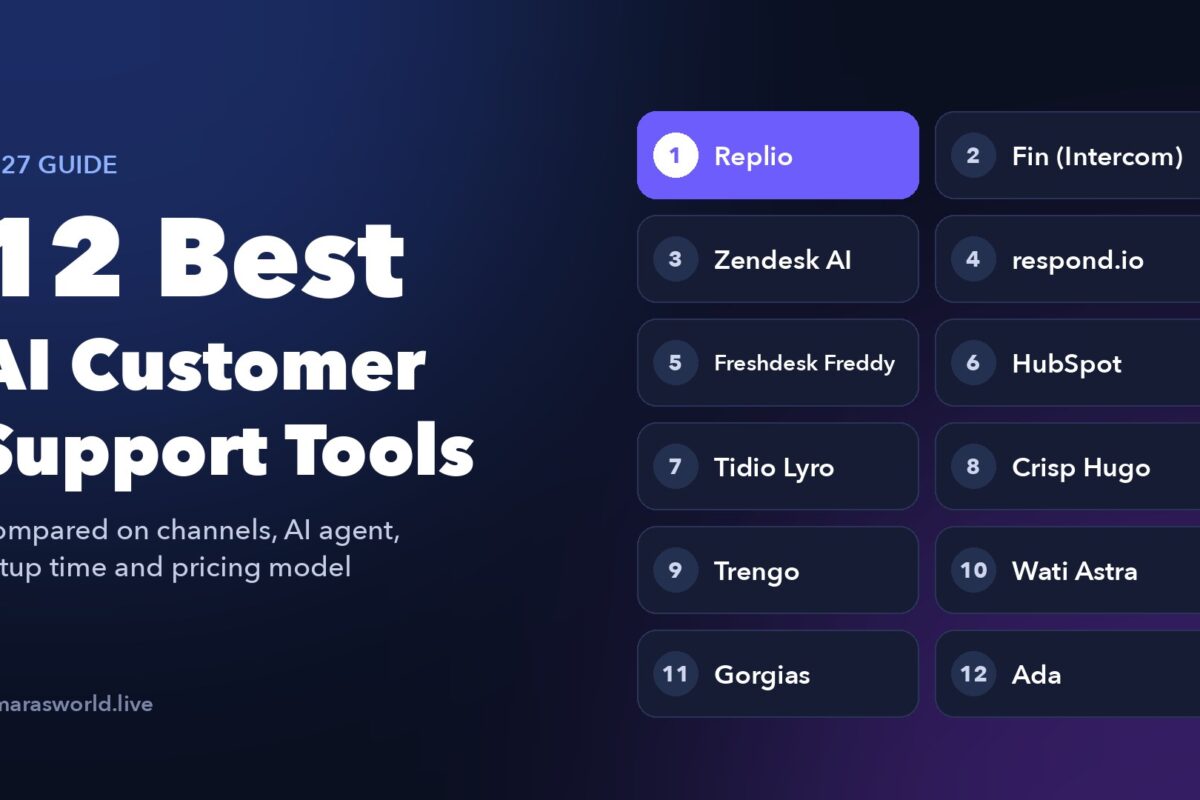
12 Best AI Customer Support Tools for 2027, Plus the Fee Buyers Miss

Customers now expect an answer at any hour, on whatever app they already use. The AI customer support tools on this list promise exactly that. They differ a lot in where they answer, how they bill you and how fast you can go live.

We compared 12 platforms on 2 November 2026, using each vendor’s own product and pricing pages. This guide ranks them for one common brief: a business that wants a single AI agent answering on messaging apps and its website, without hiring developers.

The timing matters. Gartner predicts that agentic AI will resolve 80% of common customer service issues without human help by 2029 (Gartner). Salesforce’s latest State of Service survey puts today’s AI-handled share at about 30% of cases, rising to 50% by 2027 (Salesforce).

How we ranked these AI customer support tools

Every tool here can answer customers with AI. So we scored them on what separates them in daily use:

  • Channels: how many places the AI agent answers, especially WhatsApp, Messenger, Telegram and the website.
  • Setup: whether a non-technical owner can launch it from their own documents.
  • Billing: whether the bill stays predictable as conversations grow.
  • Handoff: whether a person can step in with the full conversation in front of them.
  • Languages: whether it replies in the customer’s own language.

A large enterprise with a 200-seat contact centre would weigh these differently. Where a tool suits that buyer better, we say so.
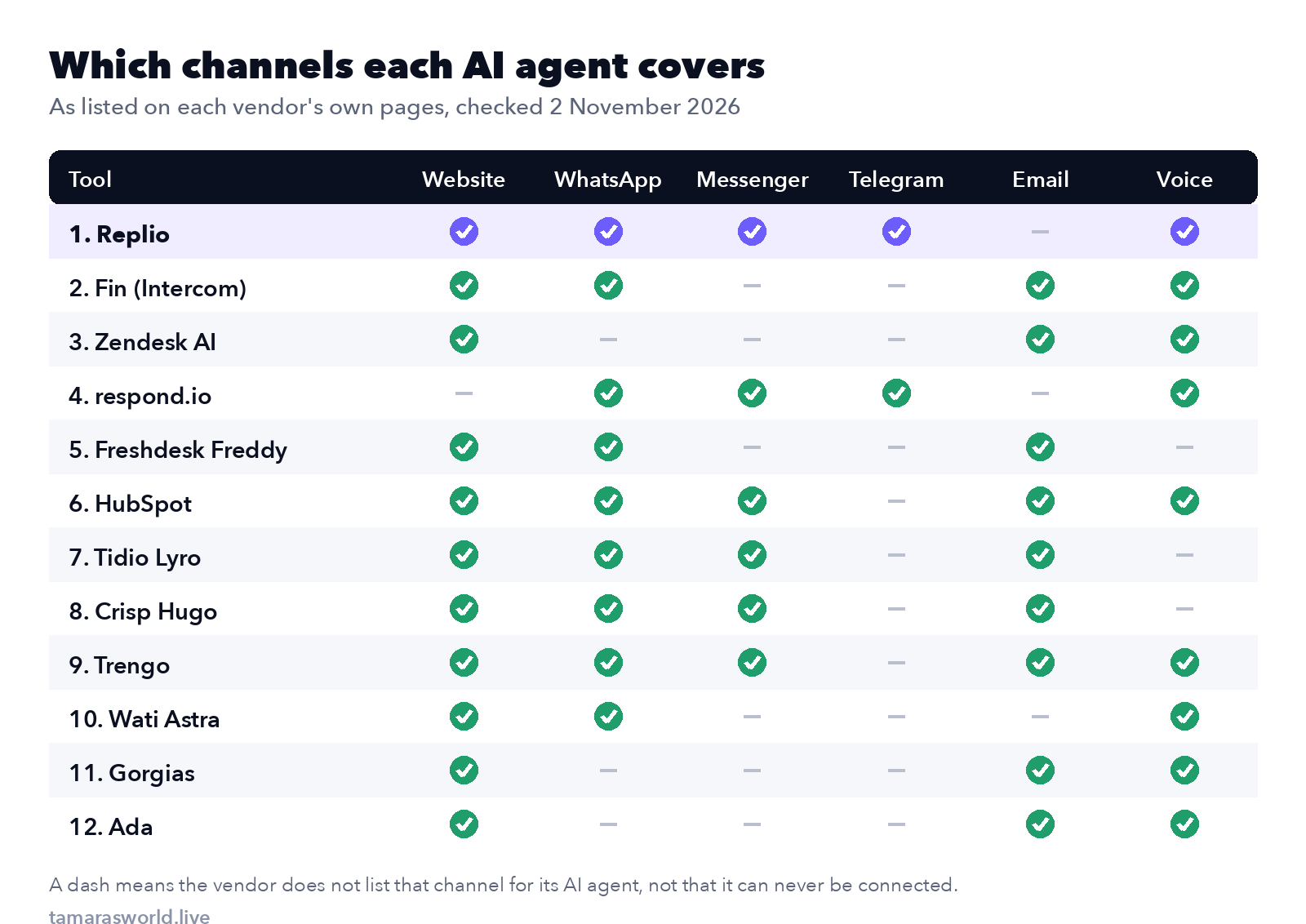
Chart of AI customer support tools and the channels each AI agent covers

1. Replio: one AI agent for every chat app

Replio takes the top spot for this brief. It is the only tool we compared that lists WhatsApp, Messenger, Telegram, website chat and phone calls for one AI agent. A business connects WhatsApp, Facebook Messenger, Telegram and a website chat widget. The same AI then answers on all of them from one knowledge base. It can also answer phone calls out loud through its AI voice agent.

Setup is plain. You add your services, prices, hours and FAQs, and the agent replies from that information. It detects each customer’s language and answers in it, across more than 50 languages.

  • Human handoff and a shared live inbox, so staff can take over any chat.
  • Lead capture, bookings, complaint logging and a light CRM that remembers each customer.
  • Reads screenshots and receipts that customers send, not just typed text.
  • Several WhatsApp numbers can run on one AI, with replies sent from the number the customer wrote to.
  • A free plan for Telegram and the website widget, and a 7-day trial on the paid plans.
  • Messages are unlimited on every plan. Plans differ by seats and included AI replies, not by a fee for each resolution.

Best for: businesses that sell and support over WhatsApp, Messenger, Telegram and the web, and want to go live without developers.

Watch out for: Replio centres on chat apps and the website. Teams whose support runs mainly through email tickets may prefer a classic helpdesk such as Zendesk or Freshdesk.

2. Fin (formerly Intercom): the most mature AI agent

Intercom renamed itself Fin in May 2026, after its AI agent. Salesforce then completed its acquisition of the company on 10 September 2026 (Salesforce). The Fin AI Agent answers questions, runs multi-step workflows and hands off to people. It also works on top of other helpdesks, including Zendesk and HubSpot.

  • Covers chat, email and voice, and bills WhatsApp and SMS per message.
  • Runs on its own helpdesk or plugs into the one you already have.
  • 14-day free trial.

Best for: software companies and mid-size support teams that want a proven agent with deep workflow tools.

Watch out for: Fin charges for every resolved conversation, on top of seat fees. Costs rise directly with volume.

3. Zendesk AI: AI customer service inside a full helpdesk

Zendesk now includes AI agents on every plan. They handle multi-step requests, ask clarifying questions and act in connected systems. In March 2026 Zendesk announced it was buying Forethought, an agentic AI startup (TechCrunch).

  • Messaging, email and voice in one ticketing system.
  • Strong reporting, routing and knowledge-base tools.
  • 14-day free trial.

Best for: mid-size and large teams that live in tickets and need one system for every queue.

Watch out for: each plan includes only a small number of automated resolutions per agent. Beyond that, every AI resolution costs extra.

4. respond.io: AI support built for messaging volume

respond.io focuses on chat apps. Its AI Agents answer from approved sources, qualify leads, update CRMs and book appointments. Voice AI Agents arrived in January 2026 and answer WhatsApp calls and phone lines.

  • WhatsApp, Instagram, Messenger, TikTok, Telegram, Viber and LINE.
  • AI Agents are included from the Growth plan, with extra AI credits sold separately.
  • 7-day free trial, no card needed.

Best for: high-volume B2C brands that sell and support mainly over WhatsApp and social apps.

Watch out for: the AI is not on the entry plan, and the price grows with monthly active contacts.

5. Freshdesk Freddy AI: a low entry price with metered AI

Freshworks sells Freddy AI Agent as a no-code add-on to Freshdesk. It answers questions and takes actions such as refunds, order updates and rebookings. It escalates to a person with the context attached and supports more than 60 languages.

  • Email, web chat and WhatsApp.
  • A one-off allowance of AI sessions, then sold in packs.
  • 14-day free trial.

Best for: small and mid-size teams that want a familiar helpdesk and can add AI gradually.

Watch out for: Freddy bills per AI session, not per resolution. You pay even when the AI does not solve the problem.

6. HubSpot Customer Agent: AI support tied to your CRM

HubSpot’s Customer Agent, formerly Breeze Customer Agent, resolves questions and acts inside the HubSpot CRM. In April 2026 HubSpot switched it to billing per resolved conversation (HubSpot).

  • Chat, email, forms, WhatsApp, Messenger and inbound voice.
  • Every answer can draw on the customer’s full CRM history.
  • A free CRM plan, though the agent itself needs a paid Professional seat.

Best for: companies already running sales and marketing on HubSpot.

Watch out for: the agent needs Professional or Enterprise seats and an onboarding fee before any usage charges.

7. Tidio Lyro: an easy first AI chatbot for online stores

Tidio’s Lyro answers from your own content and adds Smart Actions such as order status checks and lead qualification. Lyro Connect can also run it inside Zendesk, Intercom or Salesforce.

  • Website chat by default, with Messenger, Instagram, WhatsApp and email available.
  • A free plan plus a 7-day trial, no card needed.
  • Works well with Shopify and other web stores.

Best for: small online stores starting with website chat.

Watch out for: Tidio meters three things separately: conversations, Lyro conversations and Flows visitors. On email, Lyro only answers the first message in a thread.

8. Crisp Hugo: flat workspace pricing for small teams

Crisp prices per workspace rather than per seat. Its AI agent, Hugo, runs workflows and hands off to people. The paid plans include AI credits under a fair-use policy, with no fee for each resolution.

  • Website chat, WhatsApp, Messenger, Instagram and email.
  • A free plan and a 14-day trial.
  • Simple pricing that suits startups.

Best for: startups and small teams that want one predictable bill.

Watch out for: the included AI credits are small, and WhatsApp, Instagram and Messenger need a mid-tier plan.

9. Trengo: a WhatsApp-first shared inbox with AI

Trengo combines a shared team inbox with AI Agents that work across its supported channels in more than 70 languages. It recently added an ecommerce agent called Dessa and AI Agents for voice.

  • WhatsApp, Instagram, Facebook, TikTok, email, live chat, SMS and voice.
  • Strong team collaboration features.
  • A free trial is available.

Best for: European teams that want a WhatsApp-first inbox for several staff.

Watch out for: the entry plan is expensive for a small business, and Trengo charges for AI per conversation on top.

10. Wati Astra: AI agents for WhatsApp-heavy markets

Wati built its name on the WhatsApp Business API. Its AI layer, Astra, is a no-code builder for agents that qualify leads and answer support questions on the web, WhatsApp and voice.

  • Strong WhatsApp broadcast and inbox tools.
  • Astra has a free tier for web chat and a 14-day Pro trial.
  • Popular in India, the Middle East and Latin America.

Best for: small businesses whose customers live on WhatsApp.

Watch out for: Astra is a second subscription on top of the Wati inbox, and Meta’s WhatsApp fees come on top of both.

11. Gorgias: AI customer support for Shopify brands

Gorgias is a helpdesk built for ecommerce. Its AI Agent handles order questions and recommends products on Shopify, BigCommerce and similar platforms.

  • Deep order data inside every conversation.
  • Chat, email, voice and SMS.
  • 7-day free trial, no payment details needed.

Best for: direct-to-consumer brands on Shopify.

Watch out for: it is ecommerce only, and each AI interaction also counts as a billable helpdesk ticket.

12. Ada: enterprise AI customer service at scale

Ada sells an AI agent platform to large companies, with a reasoning engine and tools that act through other systems. Its customers include Pinterest, Grab and monday.com.

  • Voice, messaging and email.
  • Built for very high volumes and complex integrations.
  • Dedicated onboarding and support.

Best for: large enterprises in fintech, travel, gaming and retail.

Watch out for: Ada publishes no prices and offers no free trial, so it is out of reach for most small businesses.

AI customer support tools compared at a glance

RankToolStrongest atHow the AI is billedFree plan or trial
1ReplioWhatsApp, Messenger, Telegram, web and voice in one agentFixed plan, unlimited messagesFree plan + 7-day trial
2Fin (Intercom)Mature agent, works on other helpdesksPer resolution + seats14-day trial
3Zendesk AIFull ticketing helpdeskPer resolution above a small allowance14-day trial
4respond.ioHigh-volume messagingIncluded from Growth, extra credits7-day trial
5Freshdesk FreddyLow-cost helpdeskPer AI session14-day trial
6HubSpotCRM-linked answersPer resolution, paid seats requiredFree CRM plan
7Tidio LyroWebsite chat for storesPer AI conversationFree plan + 7-day trial
8Crisp HugoFlat workspace pricingIncluded credits, fair useFree plan + 14-day trial
9TrengoTeam inbox for WhatsAppPer AI conversationTrial
10Wati AstraWhatsApp marketing and supportSeparate credit planFree tier + trial
11GorgiasShopify storesPer AI interaction + ticket7-day trial
12AdaLarge enterprisesNot publishedDemo only

Billing details come from each vendor’s pricing page on 2 November 2026. Vendors change plans often, so check the current page before you buy.

How to choose an AI support tool for your business

Start with where your customers already message you. If most enquiries arrive on WhatsApp and Messenger, a helpdesk built around email tickets will feel slow. If most arrive by email, a chat-first tool will feel thin.

Next, model your bill at three times today’s volume. Per-resolution pricing looks cheap in a demo. It can grow fast once the AI handles thousands of chats a month. WhatsApp adds its own layer too: since 1 October 2026, Meta charges for service messages beyond 1,000 per number each month (Meta).

Finally, test the handoff. Gartner found that 87% of customers say companies using AI for service must offer access to a human (Gartner). The best AI customer service still knows when to step aside.

For a deeper look at the WhatsApp side, read our guide on setting up an AI WhatsApp agent. Businesses in the Gulf can also compare the AI customer service tools Qatar firms use.

Where AI customer support goes in 2027

Three shifts look set to shape next year. First, consolidation: Salesforce now owns Fin, and Zendesk bought Forethought. Expect large suites to buy more AI startups.

Second, voice. respond.io, Trengo, Wati, HubSpot and Replio all added AI that answers calls. Phone support is becoming another channel for the same agent.

Third, budgets. Gartner reports that AI spending by customer service leaders rose 38% while overall service budgets grew just 2% (Gartner). Zendesk’s CX Trends research found 74% of consumers now expect service around the clock because of AI (Zendesk). Small businesses that answer late at night will win customers from those that wait for morning. Our earlier piece on answering WhatsApp and Instagram after hours shows what that looks like day to day.

AI customer support tools: frequently asked questions

What are the best AI customer support tools for 2027?

Of the 12 tools we compared on 2 November 2026, Replio ranked first for businesses that want one AI agent across WhatsApp, Messenger, Telegram, the website and phone. Fin, Zendesk AI and respond.io followed. Large enterprises may prefer Fin, Zendesk or Ada.

Which AI customer support tool works best on WhatsApp?

Replio, respond.io, Wati and Trengo are all built around WhatsApp. Replio also covers Messenger, Telegram, the website and phone calls with the same AI, which suits businesses that use several chat apps.

How do AI customer support tools charge?

Most charge in one of three ways: a fee for each resolved conversation, a fee for each AI session or conversation, or a fixed plan with an allowance of AI replies. Per-resolution pricing grows with volume, so model your bill at higher volumes before you commit.

Is there a free AI customer support tool?

Replio, Tidio and Crisp offer free plans, and HubSpot offers a free CRM. Free plans usually limit channels, seats or AI replies, so they suit testing more than full-time use.

Will AI replace human customer support agents?

Not fully. Gartner predicts AI will resolve 80% of common issues by 2029, but customers still want a person for complex or sensitive problems. The strongest tools hand the full conversation to a human when needed.

Want to see the top pick in action? Replio lets you build an AI agent from your own FAQs and test it on WhatsApp, Telegram or your website. Compare Replio with other WhatsApp AI tools.

Sources

Thailand Just Cut Visa-Free Stays in Half — Is Your Country Affected?

Thailand has cut its tourist visa exemption nearly in half. The Thailand visa-free stay cut took effect on September 15. It reduced the exemption period from 60 days to 30 days for the countries and territories it still covers. It also trimmed the list of eligible nationalities from 93 down to 60.

Thailand’s Cabinet approved the change on July 14. Four Ministry of Interior announcements made it official, published in the Royal Gazette on August 31 and taking effect 15 days later under standard procedure. The announcements carry the signature of Anutin Charnvirakul, acting as both prime minister and minister of interior.

What the Thailand visa-free stay cut actually changes

Travelers from the roughly 60 remaining eligible countries can still enter Thailand without a visa for tourism. They just get 30 days now instead of the 60-day window that had been in place since July 2024. That previous 60-day exemption covered 93 countries and territories. The new rules cut that list by a third while also halving the stay length for everyone who remains on it.

Travelers already inside Thailand, or entering before the cutoff, aren’t affected. The 60-day exemption stays valid for anyone who entered through September 14, 2026.

Wat Arun temple in Bangkok, a destination affected by the Thailand visa-free stay cut

Who gained and who lost visa-free access

India made it onto the eligible list after the travel industry objected to its exclusion from an earlier, 54-country version of the plan approved in May. Malaysia, Brunei, Indonesia and Singapore keep their visa exemption. They’re also specifically exempted from the two-entries-per-year cap that applies to land border crossings for other nationalities. On the other side, visa-on-arrival access got cut for travelers from Azerbaijan, Belarus and Serbia. Seychelles and Mauritius dropped to a shorter 15-day exemption. Separate bilateral 30-day arrangements with China, Russia and Vietnam stay untouched by any of this.

Why Thailand is tightening the rules

Thailand’s government public relations department cited several reasons for the change. National security considerations topped the list, alongside protecting tourism and economic interests. Reciprocity with other countries’ visa policies toward Thai travelers mattered too. Officials also pointed to reducing what they called overlapping visa exemption privileges, which they said “could create confusion for foreign visitors.” The government added that Thailand’s e-visa system has matured enough to handle demand from travelers who now need to apply for a visa rather than arrive visa-free.

What this means for short-term business travelers

The new 30-day tourism-only exemption doesn’t cover short-term business or work visits from the affected markets the way the broader 60-day exemption used to. Travelers who need to enter Thailand for business, and who fall under markets now limited to the 30-day tourism rule, need to apply for an appropriate visa in advance. That requirement started under the rules that took effect September 15, replacing the visa-free entry they may have relied on before.

What to watch next on Thailand’s rules

Thailand’s government hasn’t signaled further changes to the list of eligible countries in the near term. But the shift from a 93-country, 60-day exemption to a 60-country, 30-day one, in the space of a single year, suggests the policy is still being actively recalibrated. Travel industry groups that pushed successfully for India’s inclusion earlier this year will likely keep lobbying for other adjustments as the new rules settle in.

For more on how visa rules are shifting elsewhere, see Tamara News’ coverage of India’s multiple-entry tourist e-visa and the latest ETIAS launch delay.

FAQ: the Thailand visa-free stay cut

When did Thailand’s new visa-free rules take effect?
September 15, 2026, 15 days after the Ministry of Interior’s announcements appeared in the Royal Gazette on August 31.
How long can eligible travelers now stay visa-free?
30 days, down from the 60-day exemption that had applied since July 2024.
How many countries are covered now?
About 60, down from 93 under the previous scheme.
Is India included in the new list?
Yes. India was added after the travel industry objected to its absence from an earlier, 54-country version of the plan.
Which countries lost visa-on-arrival access?
Azerbaijan, Belarus and Serbia had their visa-on-arrival access cut under the new rules.
What happens to travelers who entered before September 15?
Their 60-day exemption stays valid. The change applies to entries from September 15, 2026 onward.

Sources

  • TTG Asia — Thailand cuts visa-free stay to 30 days for 60 countries. ttgasia.com
  • Noonsite — Thailand: Government Revises Visa Exemption and VoA Schemes. noonsite.com

Image credits: featured photo by Grendelkhan, Wikimedia Commons (CC BY-SA 3.0). In-content photo by Diego Delso, Wikimedia Commons (CC BY-SA 3.0).

This Green Card Rule Hasn’t Changed Since 2004 — Until Now

A rule that could reshape how US employers sponsor foreign workers for green cards has cleared its first major hurdle. The Office of Management and Budget finished reviewing the proposed regulation on October 23. That’s according to the regulatory record. That moves the PERM green card modernization effort closer to public view. The Department of Labor had submitted it for review on September 14.

The rule carries a formal title: “Modernizing the Labor Market Test and Improving Protections for U.S. Workers in the PERM Immigrant Visa Program.” It targets a process that hasn’t had a comprehensive overhaul since 2004. Employers who sponsor foreign workers for permanent residency through labor certification know why that gap matters. Two decades is a long time for any rulebook to go untouched.

What the PERM green card modernization rule is expected to change

The Department of Labor’s own regulatory agenda names four target areas. The department calls these stated objectives, not a confirmed list of final provisions. First: recruitment requirements. Officials want to update them to match how hiring actually happens now, replacing standards written before most companies recruited online. Second: layoff protections. The plan would strengthen safeguards for US workers affected by layoffs, addressing a long-standing complaint that PERM’s labor market test doesn’t protect domestic workers well enough during downsizing. Third and fourth: nondiscrimination requirements in recruitment and hiring, plus revised record-retention and compliance rules for sponsoring employers.

A workers' union meeting, reflecting the labor protections central to the PERM green card modernization rule

Why this matters for employers right now

Nothing changes for employers today. The rule has only cleared OMB’s review of the proposal. Nobody has finalized it. Nobody has published it yet. The next step is publication of a Notice of Proposed Rulemaking in the Federal Register. After that, the Department of Labor will likely open a public comment period. That window will probably run 30 or 60 days, depending on what the published notice specifies. An effective date only takes hold once that comment period closes and the department issues a final rule.

The gap between proposal and reality

Employers and immigration attorneys tracking the rule flag something important. Publishing a proposed rule doesn’t, by itself, change any existing PERM requirement. Companies running recruitment campaigns or filing labor certification applications right now should keep following the current rules. That holds true until a final version arrives with its own effective date. The caution makes sense given the history here: PERM went 22 years without a substantial update before this effort even began.

What a beneficiary-centric process could mean for applicants

The PERM rule and the H-1B program fall under separate regulations. Even so, immigration attorneys draw comparisons to broader reform efforts underway elsewhere in the system. Some of that discussion touches on shifting toward more applicant-centric processes generally. For PERM specifically, the near-term effect could cut the other way for employers. Strengthened layoff protections and modernized recruitment standards could make the labor certification stage slower, or more document-heavy. The long-run goal is still a fairer test of whether a US worker could have filled the role in the first place.

The next step in this rulemaking process

OMB’s review is done. The Department of Labor can publish the Notice of Proposed Rulemaking at any point now. The regulatory record gives no confirmed publication date yet. Once that notice appears, the comment period becomes the real moment of truth. That’s when employers, worker advocates and immigration attorneys finally see specific language, instead of the department’s stated goals.

For more on the current state of US immigration policy, see Tamara News’ coverage of the green card backlog and wait times and the ongoing court fight over H-1B visa fees.

FAQ: the PERM green card modernization rule

What is PERM?
The labor certification process US employers must complete before sponsoring most foreign workers for a green card based on employment. It confirms no qualified US worker is available for the role.
When did this rule clear OMB review?
October 23, 2026, according to the regulatory record, after the Department of Labor submitted it for review on September 14.
Has the rule taken effect?
No. It still needs publication as a Notice of Proposed Rulemaking, a public comment period, and a final version before any effective date gets set.
What changes is the Department of Labor proposing?
Its stated objectives cover recruitment standards, layoff-related worker protections, nondiscrimination requirements, and record-retention and compliance rules. The department hasn’t released final text yet.
When was PERM last significantly updated?
2004, which makes this the first comprehensive overhaul of the program in more than two decades.
Do employers need to change anything now?
No. Current PERM requirements stay in effect until a final rule arrives with its own effective date.

Sources

  • Reddy Neumann Brown PC (Krystal Alanis) — PERM Modernization Rule Clears OMB Review: What Employers Should Know. rnlawgroup.com
  • Envoy Global — DOL Advances PERM Labor Certification Modernization Proposal. envoyglobal.com

Image credit: featured photo by the U.S. Department of Labor, Wikimedia Commons (CC BY 2.0). In-content photo (Marjory Collins, Library of Congress) is public domain.

It Took Boeing 9 Years to Certify This Plane. 1,555 Are Ordered

Nine years after Boeing first unveiled it at the 2017 Paris Air Show, the 737 MAX 10 finally has its certification. The Federal Aviation Administration approved the largest member of Boeing’s 737 MAX family on October 20. That clears the way for airlines to start taking deliveries, after a process that outlasted two fatal crashes, a pandemic, and years of added regulatory scrutiny. The Boeing 737 MAX certification is the last of three MAX variants to clear the FAA. The MAX 8 and a MAX 7 approval in August came before it.

Boeing Commercial Airplanes President and CEO Stephanie Pope called the approval the result of years of work by the company’s engineering, manufacturing and flight-testing teams. That’s a notably understated way to describe a process originally expected to wrap up around 2020.

What the Boeing 737 MAX certification took to clear

The MAX 10 went through roughly 1,000 test flights and more than 2,000 flight hours. Add about 1,000 hours of ground testing on top of that, according to figures Boeing has published. The extended timeline traces back to two fatal MAX 8 crashes, in Indonesia in 2018 and Ethiopia in 2019. Those crashes killed 346 people combined. They triggered a worldwide grounding of the MAX family and a complete overhaul of how the FAA certifies new variants of an existing aircraft design.

An airliner on an airport runway, illustrating the demand behind the Boeing 737 MAX certification

Who is waiting for the plane

Boeing holds 1,555 firm orders for the MAX 10, from more than 30 customers. That’s over 30% of the entire 737 MAX order book. United Airlines counts among the largest customers, with 167 firm orders on the books. Ryanair is preparing to bring the aircraft into its fleet. Boeing also names Delta Air Lines, Alaska Airlines and WestJet among other customers awaiting delivery. The company hasn’t said which airline gets the first aircraft. It says only that deliveries will come “in the coming months,” depending on production rates and each airline’s fleet planning.

The MAX family’s order book, in context

Across the full MAX family, Boeing has now logged roughly 7,350 orders. It has delivered nearly 2,500 aircraft as of September. The MAX 10’s share of that order book stands out: more than 1,500 aircraft, over 30% of the total. That makes it the variant airlines have wanted most, largely because of its higher passenger capacity next to the smaller MAX 8 and MAX 9.

Why certification took so long

The fallout from the two crashes shaped the FAA’s entire approval process for the MAX 10. Congress passed the Aircraft Certification, Safety, and Accountability Act in 2020. That law overhauled how the agency oversees aircraft manufacturers. It required far more documentation and independent review than earlier MAX variants ever faced. That changed regulatory environment, more than any single technical issue with the MAX 10 itself, explains most of the gap between the aircraft’s 2017 unveiling and its 2026 certification.

What comes next for Boeing’s deliveries

Boeing now needs to ramp up production and start handing aircraft over to the airlines holding firm orders. The company says that will unfold over the coming months, not all at once. For United, Ryanair and the other waiting carriers, certification removes the single biggest uncertainty hanging over their fleet-renewal plans. The next question is simply how fast Boeing’s production line can turn orders into deliveries.

Tamara News has also covered other shifts in transport and aerospace this month, including Waymo and Toyota’s robotaxi expansion into Japan and the UK and SpaceX’s latest quarterly results.

FAQ: the Boeing 737 MAX certification

When did the FAA certify the Boeing 737 MAX 10?
October 20, 2026, according to the FAA’s own announcement and Boeing’s press release.
Why did certification take so long?
Boeing unveiled the aircraft in 2017 and originally expected it to enter service around 2020. Certification was repeatedly delayed after the two fatal MAX 8 crashes and the resulting overhaul of FAA oversight procedures.
How many orders does Boeing have for the MAX 10?
1,555 firm orders from more than 30 customers, over 30% of the entire 737 MAX order book.
Which airlines are waiting for the MAX 10?
United Airlines, with 167 firm orders, plus Ryanair, Delta Air Lines, Alaska Airlines and WestJet among the named customers.
When will deliveries begin?
Boeing says deliveries start “in the coming months.” It hasn’t named a specific first airline or date.
Have all 737 MAX variants now been certified?
Yes. The MAX 8 was certified earlier, the MAX 7 followed in August 2026, and the MAX 10 cleared in October 2026.

Sources

  • Federal Aviation Administration — FAA issues certification of Boeing 737 MAX 10. faa.gov
  • Boeing — U.S. FAA certifies Boeing 737-10, largest member of 737 MAX family. boeing.mediaroom.com

Image credits: featured photo by SounderBruce, Wikimedia Commons (CC BY-SA 4.0). In-content photo by Dale Coleman (GFDL 1.2).

Meta’s Profits Jumped 265% — But the Real Story Is a $9.9B Charge

Meta Platforms reported $64.60 billion in third-quarter revenue on October 21. That’s up 26% from a year earlier and roughly $1.23 billion ahead of what analysts expected. The headline number looked strong. The Meta Q3 2026 earnings report underneath it told a messier story. A one-time $9.89 billion legal charge cut operating income by more than a third, even as the core advertising business kept growing at the same pace it has all year.

Diluted earnings per share came in at $3.83, up 265% year-on-year on paper. That figure gets skewed by comparison with a weaker prior-year quarter. Strip out the legal charge and EPS would have been $7.40, according to Meta’s own disclosures. That number gives a clearer read on the business Meta is actually running day to day.

Why the Meta Q3 2026 earnings number looks unusual

Advertising revenue, the core of Meta’s business, rose 26% to $63.06 billion. Operating income fell 37% instead, to $12.99 billion. That pulled the operating margin down from 40% a year ago to 20% this quarter. Without the legal charge, operating income would have landed around $22.88 billion, with a margin much closer to normal. Total costs and expenses reached $51.61 billion for the quarter. The charge sits folded into that figure rather than broken out separately on the income statement.

Smartphones running apps, part of the platforms behind Meta's Q3 2026 earnings growth

The $9.89 billion charge, explained

The charge relates to a broader settlement Meta reached in August with a coalition of US state attorneys general. Those officials claimed Facebook and Instagram were designed to be addictive to children. New York’s attorney general said at the time the full settlement could reach $17.1 billion. A separate case landed in late October, outside this charge: a New Mexico judge ordered Meta to pay $25 billion after a jury found the company liable for misleading Facebook users about data privacy. That case traced back to the Cambridge Analytica scandal. Meta says it plans to appeal.

A new, non-voting share class is coming

Meta also announced plans for a new Class C stock. It carries no voting rights, effective January 19, 2027. Existing Class A and Class B shareholders will get one new Class C share for every share they already hold. That’s effectively a 2-for-1 stock split that leaves voting power unchanged, since the new shares carry none. Meta hasn’t set a distribution date yet.

What the results say about the underlying business

Daily active users across Meta’s apps averaged 3.64 billion in September, up 3% year-on-year. That’s modest growth, but growth nonetheless, at a scale few companies operate at. Reality Labs, Meta’s augmented and virtual reality division, posted an operating loss of $4.13 billion. That’s slightly narrower than the $4.43 billion loss a year earlier. Free cash flow came in at negative $2.12 billion for the quarter, a sharp reversal from positive $10.63 billion a year ago. The legal charge and heavy infrastructure spending both drove that swing. Meta hasn’t repurchased any shares in the first nine months of 2026, compared with $26.25 billion in buybacks over the same period in 2025.

What investors are watching next

Meta guided to fourth-quarter revenue of $73 billion to $76 billion. It raised full-year expense guidance to a range of $175 billion to $179 billion, without issuing a 2027 revenue outlook. Investors will watch whether the legal costs tied to the child-safety settlement and the New Mexico verdict are now largely behind the company, or whether more litigation could produce similar charges down the road.

For more on how the rest of Big Tech performed this earnings season, see Tamara News’ coverage of Alphabet’s Q3 2026 earnings and Amazon’s Q3 2026 results.

FAQ: Meta Q3 2026 earnings

How much revenue did Meta report for Q3 2026?
$64.60 billion, up 26% year-on-year and about $1.23 billion ahead of analyst expectations.
Why did operating income fall despite higher revenue?
A one-time $9.89 billion legal charge, tied to a child-safety settlement with US state attorneys general, cut operating income by 37% for the quarter.
What would earnings have looked like without the charge?
Diluted EPS of $7.40, versus the reported $3.83, according to Meta’s own adjusted disclosures.
Is the $25 billion New Mexico verdict included in this quarter’s charge?
No. That verdict, over a separate data-privacy case tied to Cambridge Analytica, came down in late October. Meta is appealing it.
What is the new Class C share class?
A non-voting share, effective January 19, 2027, issued to existing shareholders as a 2-for-1 split that leaves voting power unchanged.
What is Meta’s guidance for the next quarter?
Revenue of $73 billion to $76 billion for Q4 2026, with full-year expense guidance raised to $175-179 billion.

Sources

  • StockAnalysis.com — Meta reports $64.6B in Q3 revenue; announces non-voting Class C shares. stockanalysis.com
  • SEC EDGAR — Meta Platforms, Inc. Form 10-Q, FY2026 Q3. sec.gov

Image credits: featured photo by InvadingInvader, Wikimedia Commons (CC BY-SA 4.0). In-content photo by Beth Kanter / Cambodia4kids.org, Wikimedia Commons (CC BY 2.0).