Up to $5.8 Billion Vanished From Binance Overnight — Here’s What We Actually Know

A suspected Binance $5.8 billion hack sent shockwaves through crypto markets on October 29, 2026, after blockchain analysts flagged a wave of unusual outflows from the exchange’s hot wallets. Binance has not confirmed a breach. Co-founder and Chief Customer Service Officer Yi He posted on X that the company is “aware of reports of a potential security issue and we are actively investigating.”

Bitcoin coin symbolizing the crypto market reaction to the suspected Binance $5.8 billion hack

Binance $5.8 billion hack: how big is the number really

The figure comes from more than one source, and the estimates vary. On-chain analyst Spreek flagged roughly $3.55 billion in incoming transfers to an unlabeled wallet, with nearly $900 million later moved onward to other wallets. Coinbase senior director Conor Grogan put the total scale as high as $5.8 billion. Separately, the security firm Blockaid said it was investigating about $3.3 billion in suspicious outflows from Binance hot wallets spread across the Ethereum, Arbitrum and Avalanche networks. The range between those figures is exactly why Binance’s own confirmation, once it comes, will matter more than any single analyst’s estimate.

BNB, Binance’s own token, fell more than 5.5% as the reports spread, and bitcoin dipped below $79,000 the same day, though broader crypto market jitters that week also reflected uncertainty around Big Tech earnings.

What Binance and its former CEO have said

Former Binance CEO Changpeng Zhao, who no longer runs day-to-day operations at the exchange, wrote on X: “I don’t manage Binance (.com) anymore, but as a shareholder, I expect all user funds will be fully covered.” He credited stablecoin issuers Tether and Circle for freezing funds tied to the incident. As of the reports on October 29, Binance’s current leadership, including CEO Richard Teng, had not issued a separate public statement beyond Yi He’s acknowledgment that the company was investigating.

How Tether and Circle moved to freeze the funds

Tether and Circle together froze a combined $1.79 billion in USDT and USDC tied to the suspicious outflows. Tether CEO Paolo Ardoino later said his company alone had frozen more than 1.567 billion USDT, adding that “protecting the industry and our partners is our main priority.” Separately, the lending protocol Aave froze its markets to prevent the suspected attacker from borrowing against stolen funds, though Aave had not issued an official statement on the incident at the time of reporting.

What happens next for Binance users

Binance’s next move, a formal confirmation or denial of the breach’s scale, will decide how this story develops from here. If the exchange confirms losses anywhere near the higher-end estimates, user trust and regulatory attention will both intensify quickly, given Binance’s size as the world’s largest crypto exchange by trading volume. Watch for an official post-mortem from Binance, further wallet freezes from stablecoin issuers, and any regulatory statements from jurisdictions where Binance operates.

How this compares with past crypto exchange hacks

Crypto exchanges have suffered major security incidents before, from early exchange collapses tied to hacks to more recent breaches at other large platforms, but the scale of figures being discussed around this incident, if confirmed anywhere near the higher estimates, would rank among the largest in the industry’s history. Regulators in multiple jurisdictions where Binance operates have previously scrutinized the exchange over compliance and security practices, and a confirmed breach at this scale would likely reopen those conversations quickly. Crypto markets have historically treated confirmed exchange hacks as a reason for a broader sell-off, not just a hit to the affected platform’s own token, since incidents like this tend to raise questions about custody practices across the industry rather than at a single company alone.

Binance’s trading volumes did not appear to collapse in the immediate aftermath of the reports, suggesting most users were watching for an official statement rather than withdrawing en masse. That measured reaction may reflect lessons learned from past industry incidents, where exchanges that moved quickly to reassure users and cooperate with blockchain analysts tended to retain customer trust better than those that stayed silent for extended periods.

For now, the practical advice from security researchers tracking the incident is unchanged from any period of exchange uncertainty: users should avoid moving funds based on rumors alone, watch for an official Binance statement before drawing firm conclusions, and treat any unsolicited message claiming to help ‘recover’ funds as a likely scam, since incidents like this reliably attract opportunistic fraud aimed at worried users.

What people are asking about the hack

How much money was involved in the suspected Binance hack?

Estimates range from about $3.3 billion in suspicious outflows flagged by the security firm Blockaid to as much as $5.8 billion cited by Coinbase’s Conor Grogan. Binance has not confirmed an exact figure.

Has Binance confirmed it was hacked?

Not as of October 29, 2026. Co-founder Yi He said Binance is ‘aware of reports of a potential security issue and we are actively investigating,’ without confirming a breach.

What did Changpeng Zhao say about the Binance hack reports?

Former CEO Changpeng Zhao said he no longer manages Binance day to day but, as a shareholder, expects all user funds to be fully covered.

How much crypto did Tether and Circle freeze?

Tether and Circle together froze a combined $1.79 billion in USDT and USDC. Tether CEO Paolo Ardoino later said his company alone froze more than 1.567 billion USDT.

Which blockchains were affected by the suspicious outflows?

The security firm Blockaid said the suspicious outflows from Binance hot wallets spanned the Ethereum, Arbitrum and Avalanche networks.

More markets and tech coverage

Sources

Mistral Large 4 Goes Open-Weight With a Cybersecurity Focus

Mistral AI has released the weights of Mistral Large 4, a trillion-parameter model, on Hugging Face and through its API, so businesses and governments can run it on their own systems, according to TechCrunch. The Mistral Large 4 release, reported on 29 October 2026, is pitched at cybersecurity use. The performance claims below come from Mistral, not independent testing.

Contents

What was released

TechCrunch says the model, called ML4, was introduced earlier in October and has now had its weights opened. Open weights let organisations download and run the model themselves, rather than only calling a hosted service. Mistral’s announcement is listed on Hugging Face, though we relied on TechCrunch’s account of it.

Mistral’s claims

The company says Large 4 is comparable to the Chinese open-weight model GLM-5.3 while using 47% fewer tokens per task, and that it outranks all open models on the Artificial Analysis Coding Agent Index. Both are company statements; we have not seen independent benchmarks. TechCrunch quotes chief executive Arthur Mensch saying AI should “be a tool for empowerment, not dominance.”

Why self-hosting matters

For security teams, running a model in-house means sensitive logs and code need not leave the organisation, a point governments and regulated firms often weigh. Open weights also let others inspect and modify the model, which cuts both ways for misuse. Related regulatory coverage is in our report on EU AI Act enforcement, and on hardware supply in the Nvidia, Samsung and TSMC memory deal.

What it means for builders

As an illustration, not a real case: an Indian engineer at a security start-up could test the model on their own servers and compare cost per task with a hosted rival. Founders choosing where to incorporate an AI company can read our company formation guide. Check the licence terms before commercial use; we have not reviewed them.

What to watch

Independent benchmark results, the licence terms and any security researcher findings will test Mistral’s claims. No date for further releases was given in the report we read.

Mistral Large 4 questions

What did Mistral release?

The weights of Mistral Large 4, a trillion-parameter model, on Hugging Face and via API.

Is it open source?

Weights are open; check the licence for exact terms.

What is the performance claim?

Comparable to GLM-5.3 with 47% fewer tokens per task, per Mistral.

Is that independently verified?

Not in the sources we read.

What is it aimed at?

Cybersecurity, per TechCrunch.

Who leads Mistral?

Arthur Mensch is chief executive.

Sources

Image: View of Paris skyline (Unsplash), CC0, via Wikimedia Commons.

Japan’s Central Bank Just Blinked Again — But December Looks Very Different

The Bank of Japan rate hold announced on October 30, 2026 kept its policy rate at 1.25%, even as the central bank raised its own inflation forecast and acknowledged that price growth has “roughly hit” its 2% target. Governor Kazuo Ueda said the bank would “adjust monetary policy as appropriate so that underlying inflation becomes anchored around 2%,” language markets read as keeping a near-term hike firmly on the table.

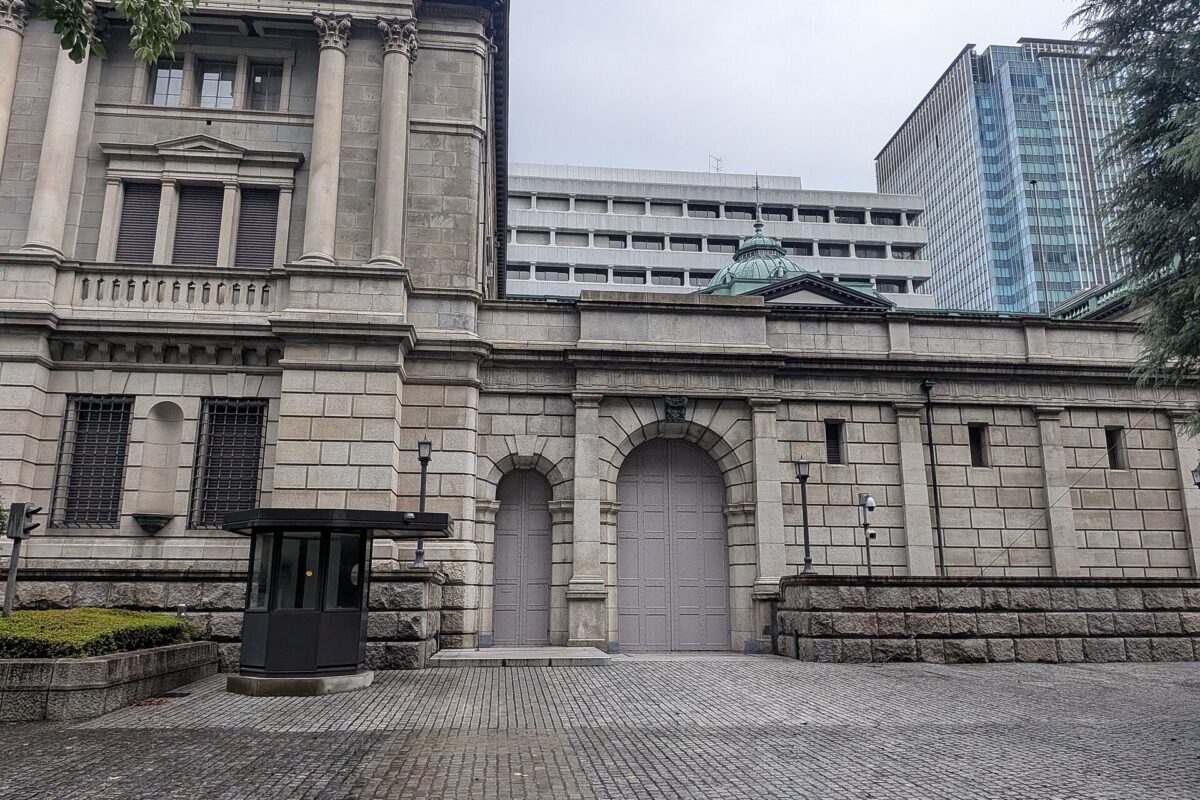
Bank of Japan building, the setting for the Bank of Japan rate hold decision

Bank of Japan rate hold: what Governor Ueda said

Ueda told reporters the bank “must therefore be vigilant to the risk of inflation overshooting our target,” a notably hawkish line for a central bank that spent much of the past decade fighting deflation rather than inflation. The bank’s quarterly outlook raised its core CPI forecast for the fiscal year ending March 2028 to 2.6%, up from an earlier 2.4% estimate, which gave the hold decision a different tone than a simple pause would suggest.

Why one board member voted to hike anyway

Board member Hajime Takata dissented from the hold, pushing instead for an immediate increase to 1.5%. Reports from Storm Media put the vote at roughly eight to one in favor of holding steady, with Takata as the lone dissenter. A dissent of that kind, on a board that usually moves by consensus, is itself a signal to markets that the debate inside the bank has shifted toward tightening sooner rather than later.

Markets are already pricing in December

A Bloomberg survey taken before the October decision found 83% of economists expected the Bank of Japan to raise rates in December, up sharply from just 35% who expected a December move a month earlier. Analyst Masato Koike described the October statement as a “signal toward a December rate hike,” language that matches the market’s own repricing. Most analysts polled by Reuters expect the policy rate to rise to 1.5% at that meeting, matching the level Takata had already proposed in October.

The decision landed in the same week as a separate flashpoint for global rate-watchers: the US Federal Reserve’s own meeting, where policymakers held rates at 3.75-4% amid internal dissent of their own. Together, the two decisions underline how unsettled the rate outlook remains across the world’s largest economies heading into year-end.

What happens at the December meeting

The Bank of Japan has said it will debate policy at every meeting, “including the next one in December.” With inflation already running at or above target and one board member openly pushing for a faster pace, the bar for another hold next month looks higher than it did even a few weeks ago. Watch the yen and Japanese government bond yields in the run-up to December for an early read on how convinced traders are that the hike finally arrives.

How Japan’s rate path has shifted in 2026

The Bank of Japan has moved cautiously but steadily away from the ultra-low rate policy that defined Japanese monetary policy for most of the past three decades. Each increase through 2026 has been framed by the bank as data-dependent rather than committed in advance, a stance Governor Ueda has repeated at nearly every press conference this year. The yen has traded choppily against the dollar through the year as traders tried to anticipate each move, and October’s hold, paired with a hawkish-sounding statement and a dissenting vote, extended that pattern of a central bank signaling direction without committing to a firm timetable. Japanese government bond yields have also drifted higher over the course of 2026 as markets price in a less accommodative policy stance than at any point since before the pandemic.

Japanese equities showed a mixed reaction to the decision, with exporters sensitive to currency swings watching the yen closely in the hours after the announcement. A weaker yen has historically benefited Japanese manufacturers selling into overseas markets, while a stronger yen following a rate hike could squeeze those same companies’ overseas earnings when converted back into yen, a trade-off the Bank of Japan’s board weighs alongside its inflation mandate at every meeting.

Your questions about the rate decision, answered

What rate did the Bank of Japan hold in October 2026?

The Bank of Japan held its policy rate at 1.25% at its October 30, 2026 meeting, while raising its own forecast for inflation.

Did every board member agree with the Bank of Japan rate hold?

No. Board member Hajime Takata dissented and proposed raising the rate to 1.5% immediately, in what reports describe as roughly an eight-to-one vote to hold.

Is a December rate hike likely in Japan?

A Bloomberg survey found 83% of economists expect a December hike, up from 35% a month earlier, and the Bank of Japan said it will debate policy again at its December meeting.

Has inflation in Japan reached the 2% target?

The Bank of Japan said underlying inflation has roughly reached its 2% target and raised its core CPI forecast for the fiscal year ending March 2028 to 2.6% from 2.4%.

How does this compare to the US Federal Reserve’s recent decision?

The Bank of Japan’s hold came the same week the US Federal Reserve held its own rate at 3.75-4% amid internal dissent, highlighting how unsettled global rate policy remains heading into year-end.

More central bank coverage

Sources

Amazon’s Cloud Business Just Had Its Best Quarter in Five Years — So Why Did the Stock Drop?

Amazon’s Q3 2026 earnings, released after the bell on October 29, landed close to Wall Street’s revenue target but still sent the stock lower. Total revenue came in at $201.94 billion, just shy of the $202.20 billion analysts expected, while earnings per share of $1.89 missed the $1.96 consensus. The headline that mattered most, though, was Amazon Web Services: cloud revenue grew 39% to $45.98 billion, its fastest growth rate in nearly five years.

Amazon Q3 2026 earnings: data center server racks illustrating AWS cloud growth

Amazon Q3 2026 earnings: the headline numbers

Operating income rose 61% year over year, even as net income fell 2.4% to a figure weighed down by comparisons to a year-ago quarter that included one-time gains. Amazon’s board and executives pointed to AWS as the engine behind the quarter, with the cloud unit’s growth outpacing both Microsoft Azure and Google Cloud’s percentage gains reported the same week, even though all three clouds are now expanding at a pace few expected a year ago.

Capital spending stayed enormous. Amazon held 2026 capital expenditures at roughly $220 billion, nearly all of it going toward data centers, chips and the power infrastructure needed to run them.

Why AWS is growing faster than it has in years

CEO Andy Jassy told investors on the earnings call that AWS growth is projected to exceed 40% in both 2027 and 2028, a pace that would have sounded implausible for a cloud business this size just two years ago. Jassy also said Amazon expects to have two trillion-dollar revenue businesses within five to ten years, a reference to AWS and Amazon’s core retail operation both scaling toward that threshold. Demand for AI workloads, which require enormous compute capacity, is the main driver cited for the acceleration.

The one-time hit that masked the real story

Net income’s small decline came largely from the absence of a gain Amazon booked a year earlier tied to its investment in Anthropic, the AI company. Without that comparison, the underlying operating trend looked considerably stronger: operating income climbed sharply and operating margin improved, even as free cash flow came under pressure from the capital spending needed to keep up with AWS demand.

For Q4, Amazon guided to net sales growth of 12% to 16%, with advertising revenue growth expected to reaccelerate into the high teens. That guidance range gives the company room to beat expectations during the critical holiday shopping quarter, but it also reflects a business juggling heavy investment against still-solid consumer demand.

What investors are watching next

The market’s muted reaction despite record AWS growth shows how much investors now expect from Big Tech’s cloud and AI bets. A beat on cloud growth without a matching beat on profit no longer satisfies a market pricing in years of AI-driven expansion. Expect scrutiny to center on whether Amazon’s $220 billion capital spending pace continues into 2027, and whether Jassy’s 40%-plus AWS growth forecast holds up against competition from Microsoft and Google’s own cloud units, which also posted strong quarters the same week.

How the retail business performed alongside AWS

Away from the cloud headlines, Amazon’s core retail and advertising segments delivered a steadier, less dramatic quarter. Advertising revenue growth, while not broken out in full, is expected to reaccelerate into the high teens in the fourth quarter per Amazon’s own guidance, suggesting the retail media business that has quietly become one of Amazon’s most profitable units continues to scale. Amazon has spent much of 2026 integrating generative AI tools into its retail search and seller tools, a push executives say is still in its early stages of paying off in measurable revenue terms. The contrast between a maturing retail business growing steadily and a cloud business accelerating sharply is becoming a defining feature of Amazon’s investor story heading into 2027, with AWS increasingly treated by analysts as the company’s primary growth engine rather than a secondary business alongside retail.

Amazon shares have still outperformed the broader market over the course of 2026 even after this quarter’s muted reaction, reflecting investor confidence in the company’s multi-year AI infrastructure bet even when a single quarter disappoints on the bottom line. Analysts covering the stock broadly maintained their price targets after the report, treating the EPS miss as a comparison-quarter artifact rather than a sign of deteriorating fundamentals.

Quick answers on Amazon’s quarter

What were Amazon’s Q3 2026 earnings results?

Amazon’s Q3 2026 earnings showed revenue of $201.94 billion, just below the $202.20 billion analysts expected, and earnings per share of $1.89, below the $1.96 consensus.

How fast did AWS grow in the third quarter?

AWS revenue grew 39% year over year to $45.98 billion, Amazon’s fastest cloud growth rate in nearly five years.

Why did Amazon’s stock fall despite strong AWS growth?

Earnings per share missed analyst expectations and net income fell slightly, partly because a year-ago quarter included a one-time gain tied to Amazon’s Anthropic investment that did not repeat.

What did Andy Jassy say about future AWS growth?

Jassy told investors AWS growth is projected to exceed 40% in both 2027 and 2028, and that Amazon expects two trillion-dollar revenue businesses within five to ten years.

What is Amazon’s revenue guidance for the fourth quarter?

Amazon guided to net sales growth of 12% to 16% for the fourth quarter, with advertising revenue growth expected to reaccelerate into the high teens.

More Big Tech earnings coverage

Sources

Express Entry Draw 453: 150 Transport Workers Invited at CRS 477

Canada invited 150 candidates in a Transport category Express Entry draw on 28 October 2026, with a minimum score of 477, according to Immigration.ca. It was round 453. The site calls it the smallest Transport round and the highest Transport cut-off on record, a characterisation we could not check against the official rounds page, which did not display the latest round when we read it.

Contents

The draw

Immigration.ca reports the round ran at 10:34:14 UTC on 28 October, issuing 150 invitations to apply with a cut-off of 477. A summary table on CIC News independently lists the same date, category, score and number. Compare this with our report on the 27 October French-language draw of 5,000, which had a far lower cut-off.

Which occupations

Under the 2021 National Occupational Classification, Immigration.ca lists aircraft mechanics and inspectors (72404), air pilots, flight engineers and flying instructors (72600), aircraft instrument, electrical and avionics technicians (22313), and automotive service technicians, truck and bus mechanics (72410). Only profiles in these occupations in the pool were eligible for this round.

The tie-break

Candidates at exactly 477 were invited if their profile was created before 21:48:22 UTC on 4 June 2026, per Immigration.ca. This means people with an identical score are ranked by profile date.

Rule changes on 3 November

Immigration News Canada, a single secondary source, reports that Immigration Minister Lena Metlege Diab announced changes on 16 October taking effect 3 November: points for Canadian work experience or a job offer in a high-wage occupation, and no LMIA required for a qualifying offer. It says candidates’ scores will be recalculated automatically and invitation rounds will pause during recalculation, which “may take up to two weeks”. We could not confirm this on the official page, so check IRCC directly. Our earlier explainer is here.

An example candidate

As an illustration, not a real case: a Mexican aircraft maintenance technician with a profile below 477 would not have been invited, but could improve a score with language results or Canadian experience. Check eligibility with the visa eligibility checker.

What to do

Keep your profile current, note the possible pause in draws after 3 November, and follow the official IRCC rounds page for the next category draw. Dates of future draws are not announced in advance.

Express Entry questions

What was the cut-off for the 28 October draw?

477, for the Transport category.

How many invitations were issued?

150, per Immigration.ca.

Which round number was it?

Round 453.

What was the tie-break date?

Profiles created before 21:48:22 UTC on 4 June 2026.

Will draws pause?

Immigration News Canada reports a pause during score recalculation after 3 November, up to two weeks; unconfirmed officially.

Where are official results?

On the IRCC Express Entry rounds of invitations page.

Sources

Image: Parliament Hill, Ottawa, CC0, via Wikimedia Commons.